
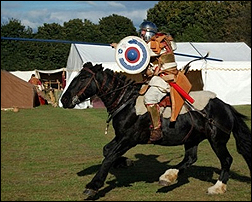


Autumn 2007.
The last year has been one the major experiences of my re-enactment career. It’s been a great journey. When I started my aim was two-fold. I wanted to learn to ride as a Roman, but also learn about the equipment as well.
Twelve months ago traditional Roman four-horned saddles were a dream of the future. Now I can’t cross my equipment room without stubbing toes on four-horned saddles, and even a steppe saddle. I initially believed the solid wooden frame of a four-horned saddle was inflexible, and potentially painful for a horse’s back. Surely, even a saddle made to fit a specific horse would cease to fit if the horse lost condition on campaign? I have changed my mind. A solid Roman saddle with a wooden frame can be made to fit most horses, with the addition of good padding in the form of a saddlecloth or furs. The same was true of the solid wooden framed military saddles of the 19th century.
My saddle horns lack the metal reinforcements found on Roman sites. I’ve broken the two rear horns at various times. But they are easy to replace, in something under four hours, with the minimum of fuss. I’ve tried stuffed saddles from Germany made without a wooden frame but with a metal bar towards the front of the saddle for stability. The cost of such a saddle is around £800, which seems high. Their weight is excessive and their size is large.
They look pretty, but everything leads me to favour a saddle with a solid wooden tree. These are produced in the UK for around £450 by the Saddlers Den. Triplet straps are great for securing equipment. Hooking your legs under the horns to secure your seat soon becomes second nature. It is a good design, but it is time consuming to produce and the horns are intrinsic weaknesses.
The steppe saddle is a much simpler and stronger design. Initially riders try and hook their legs into the front cantle, which is very uncomfortable. Instead you must ride with a straight leg and a very deep seat. Riders fear slipping out of the side door. But long legs and a deep seat keep you in the saddle. After a couple of hour’s practice I could do all our standard manoeuvres with confidence. The Comitatus group steppe saddle has no padding on the saddle itself, which is just bare wood. So the saddle needs several layers of fur between it and the horse.
I would love to know when such saddles became common in Britain. There is certainly evidence of at least one of them in 4th century France. But I find it hard to imagine them being used in northern Britain before 400AD.
To look good in public it became important to match riders with horses and give them time to get to know each other. I must once again thank Claire Chamberlain and her Full Tilt yard, near Goole, for her common sense and patience. How she stays smiling while we load horses with Roman equipment and idiotic riders, I do not know. But she allows me the time to find the right way to do it, not just the easiest.
She teamed me up with a former carriage pony, an Irish cob called Murphy. He was known as the ASBO (anti-social behaviour order) pony due to his habit of kicking other horses. I have to admit he is a wilful lazy cantankerous git. But after 6 months of several hours work each week we got to know each other. After sharing so much it’s impossible not to like him. At around 14 hands he is a good size and shape for a Roman horse.
Equipping an authentic infantryman takes time and money. Equipping an authentic cavalryman takes far more cash and a massive amount of time. Equipping four cavalrymen is a Herculean task. When I see photos of the Taifali it gives a great sense of achievement. And we have managed it on a very limited budget. However the adventure has never just been about authentic equipment.
We’ve always aimed at demonstrating the skills of the Roman cavalry. That means hours of practice. Six members have ridden at shows during 2007, and many others have enjoyed practising. You need to practice in kit, so both the rider and horse get used to it. I want the riders to be used to carrying their own equipment hanging from themselves and their saddles. That means riders have to find ways of carrying their shield, bow, arrows, lance and sometimes javelins. As the late 6th century Strategikon states, riders must be able to hang their lance from their shoulder while drawing the bow and placing an arrow on the string. They must then be able to replace the bow and ready the lance. Put simply riders must look like Roman soldiers, comfortable with their kit and weaponry. We are not all there yet, but it’s where we need to be.
Using the kontos, a 4 metre long lance necessitates holding the weapon with both hands and controlling the horse with your legs. But horse archery takes the greatest time to come to terms with. I’m sure that many second line units used the javelin or used their bows stationary But as part of the elite field army the Taifali must be able to shoot on the move.
Most of us use the western grip, but at least one of us shoots with a thumb ring in the eastern style. I’m right-handed, and shooting forward to the right of the horse’s head means I need to pull my right shoulder well backwards and stretch forward with my left arm. However, especially in locked scale, my draw length is limited, in turn limiting the power of the shot. Shooting to the rear, the famous Parthian shot, in many ways seems easier.
Trusting you horse to go one way while you face the other is very liberating! My draw length is good, but too often my left shoulder lies within the bow. The string hits my armour on the left shoulder. But when it works it feels great. Shooting to the left when doing the cantabrian circle is a basic part of the display. The rider starts with the arrow held under tension on the bow with the left hand. You are riding with the reins in the right hand. You make sure you have good speed down in front of the crowd line, put the horse into a right turn, when the horse is balanced drop the reins, relax, take the shot, find the reins, turn to the right and take the applause. But what we are not doing is placing a new arrow on the string while on the move. That is something to learn over the winter.
Something that puzzles me is just how did Romans mount up? It’s possible to do it stationary with the assistance of a spear. Fences and infantry are all good mounting blocks. A strong loop of rope over the front horns can make a useful “step” for mounting. But we are supposed to be able to mount when the horse is moving at speed!
I’m flattered at the number of compliments the Taifali receive. Robert Vermaat of Fectio in Holland was kind enough to call us the “envy of continental Europe”. But I have a very clear idea of where we need to be, and we are a long way from it. We will get better. This October the next batch of Comitatus riders started their first group training session. I firmly believe some of them will be riding in shows during 2008. They will certainly all enjoy the experience of riding like the Romans.