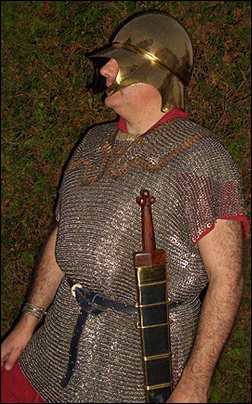
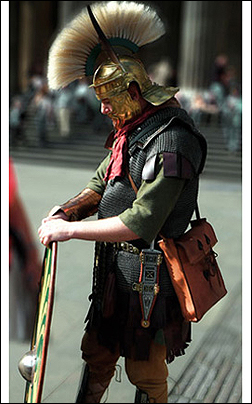
A copy of the Montefortino A helmet (Robinson’s classification) in the British Museum, 4th to 3rd century B.C. The edge of the helmet has a cabled finish, there is a small neck-guard and the crest knob is forged in one piece with the skull and is decorated with a scale pattern. The method of closure is copied from head of King Pyrrhus from Naples Museum given in Robinson page 15. Polybios states legionaries carried a plume of three purple or black feathers 1.5 feet (0.45m) high.
The large scutum was adopted by all three classes of legionary during the Latin Wars of the 4th century B.C. according to Livy. This is based on the large curved plywood shield from Kasr al-Harit in the Egyptian Fayyum.
Body armour at this time was linked to wealth and social status. Such embossed copper-alloy breastplates seem to have been backed in leather and suspended using leather straps. Relatively little is known about Republican belts and here a simple belt with bone buckle is used.
Dateline 3rd century B.C
Roman Officer
This figure is based on Duncan Head’s interpretation of the paintings of the tomb of the Fabii. Probably a Montefortino was depicted, with a feathered crest, a short plate cuirass without pteruges, two greaves and a cloak. Although generals seem to have worn red cloaks officers would show considerable variation in equipment. Paullus fought without a cuirass at the Battle of Pydna. The metal belt with hook fastenings is typical of the Samnite hill peoples.
Southern Gallic Cavalryman. 1st century B.C.
Fighting for or against Julius Caesar, this is a high status rider with “Agen” style helmet, mail armour and a long sword based on the Hod Hill example. The Romans probably adopted the four horned saddle design and the mail from the “Celts”. The rider wears a simple twist torc and carries a circular shield slung over his shoulder although other shapes are possible.
Dateline Mid 1st century BC.
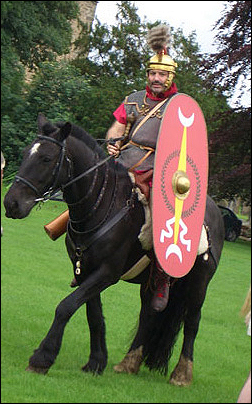
Roman cavalryman.
Based in part on the Altar of Domitius Ahenobarbus, a mail shirt with shoulder doubling is worn over a padded garment, tunic and scarf. A basic belt with bone buckle supports a commercially available Republican sword based on an example from Delos manufactured before 69 B.C. A copper alloy boeotian helmet is worn in “yellow bronze”.
Dateline 55 B.C.
Caesar’s Invasion of Britain.
Auxiliary cavalryman.
The Port helmet based on that from Port bei Nidau now in the Landesmuseum, Zurich. Over a padded subarmalis is worn a mail shirt with shoulder doubling. The spatha has a handle made from walnut with a bone grip. A Gaulish style tunic is worn, with cloak and Gaulish brooch. Short woollen trousers, bracae, are worn with socks, undones, and caligae. The circular shield is in its cover. The bag is based on find from the Comacchio shipwreck.
Dateline late 1st century
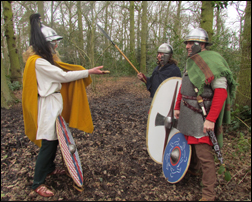
North British warriors
Waiting for the Romans to arrive in Yorkshire, a southern refugee offers his Hod Hill sword in allegiance to two tough northerners. A mix of Port Agen helmets are worn, with simple toggle belt fastenings, including a Roman enamel toggle. The chieftain wears a sword with a typical east Yorkshire organic hilt, with scabbard decorated with period iconography. Spined shields, would be rather old fashioned by this time, as would be the Great Torc from Snettisham worn by the chieftain, made around 75 BC.
Dateline 43 A.D.
The Claudian Invasion of Britain.
Legionary cavalryman.
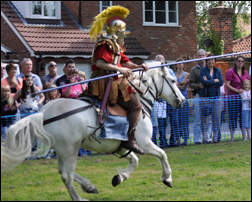
The helmet is a Coolus E, based on that from the Walbrook Stream now in the British Museum. A scarf, focale, is worn with padded subarmalis, under a mail shirt with shoulder doubling. Short woollen trousers are worn with leg wrappings and military boots. The soldier is armed with a spatha and a quiver of javelins. A large shield covers the riders left side. The design is taken from Trajan's Column.
Dateline 61 A D.
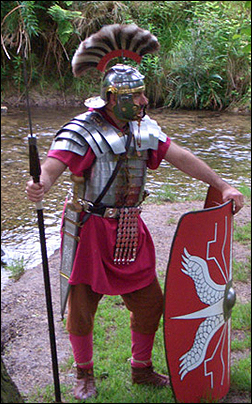
Legionary from the Boudican revolt.
The helmet is a mid 1st century example of Robinson’s Imperial Gallic 'G' from the Rhine at Mainz, now at Worms. The cuirass is a Corbridge A, worn here without padding. The pugio is an Augustan example from Titelberg, worn belt plates from Rheingonheim. The scabbard worn on the right is based on example from Vindonissa dated AD 45-69, holding a broad Mainz-type gladius. Bracae are worn with leg wrappings and military boots. An early Principate heavy pilum is carried, alongside a curved scutum of shield. The design is once again taken from Trajan's Column.
Dateline 69 A.D.
Northern Britain.
Batavian Auxiliary.
The helmet is a Robinson Italic C based on one found at Cremona, probably lost in 69AD during the battle where the Batavians were heavily involved. The spatha is based on a find from Hod Hill, an auxiliary sword from mid- 1st century. The belt or cingulum has decorations from Tekje and London, and is worn with a Batavian belt. The fox fur on the helmet echoes both Trajan's Column and written descriptions of Germanic auxiliaries as wearing furs. A mail lorica hamata with shoulder doubling is worn with a boars tusk pendant as found in Newstead, and a manica based on the find from Carlisle with the addition of a sheepskin lining. For cold weather long bracae are worn with "puttees" as found at Vindolanda.
The impedimenta of the
second half of the 1st century.
This classic legionary is in marching order, wearing his hooded cloak, the paenula, fastened down the front. His equipment is carried suspended on a pole, the furca. He carries a kit bag or loculus, leather water bottle, string ration bag, fire iron, cook pot or situla, mess tin or patera, clothes bag and basket. His entrenching tools can be seen lying on the ground behind him.
Dateline A.D. 90
Northern Britain.
Auxiliary cavalrymen.
The helmets are versions of Robinson’s Auxiliary Cavalry A, partially sheathed in silver. The mail shirt on the left has a cape-like shoulder doubling, and wears a torc. Short trousers, bracae, are worn. Footwear is a mixture of caligae and military boots. The right-hand figure is wearing a Gallic style tunic with folded back cuffs, as well as leg wraps. His spatha handle is based on an early 2nd century find from Dangstetten.
Dateline mid 1st century
Auxiliary cavalryman.
This is based on the auxiliary B cavalry helmet found at Witcham Gravel, Ely, and now in the British Museum. Largely iron sheathed in yellow bronze, the original still retains a bronze cheek piece. Yellow crests are later associated with the Roman cavalry by Arrian. Here the mail shirt rather than being worn over a form of padding is instead worn over two tunics, and secured by a relatively plane belt. Bracae and leg wraps complete the equipment.
Dateline late 1st century
Northern Britain.
Auxiliary cavalryman.
Legionaries could be equipped with bows for hunting and for war. This soldier is using a helmet based on the example from Brigetio, Hungary, now currently displayed at the Roman Army Museum, Caerleon. It has a high mounted brow guard and eyebrow decoration. The legionary is using a recurve bow, stiffened at the ears and handle with horn plates. The arrows are made from cane with wooden knocks and piles. No metal heads are needed for hunting arrows such as these. Rather than a quiver of uncertain design the soldier carries spare arrows in their bow hand.
Dateline early 2nd century.
Cavalryman with contus
Romans adopted the contus in the early 2nd century. The helmet is a copy of the 1st century find from Witcham Gravel, Ely, Cambridgeshire, worn with flexible scale armour. A rare photo of the contus used by an early Imperial Roman. The weapon is in a low position to the right of the horses neck. It could be used to break up static infantry formations, as well as against other horsemen.
Dateline early 2nd century.
Cavalryman from a Cohortes equitates.
Perhaps the hardest period to reconstruct. The Theilenhofen helmet now on display in Munich fits into the Imperial Italic tradition, but with a shallow neck guard. Found on the site of the castrum of Cohors III Bracaraugustanorum, a mixed cohort of infantry and cavalry guarding the Raetian limes. The deposition date of the helmet is 189AD although the helmet could have seen a great deal of service prior to the deposition date.
The shoulder doubling on the mail shirt would be becoming old fashioned by this date. The long spatha has an early second century cows bone grip based on a find from Dangstetten, with walnut pommel and guard with recessed copper plate. The scabbard is based on finds from Scotland and Germany. The belt has plates of open work design based on finds from Hadrian’s Wall. Caligae have gone out of fashion and here an enclosed boot is worn.
Dateline A.D. 105
The Dacian wars.
Legionary Legio II Adiutrix.
A mail hamata is depicted, here still with shoulder doubling, along with a Robinson type Imperial Gallic type I, probably made at the end of the civil wars of 68-69 A.D. A manica is worn with greaves to protect the limbs against the two-handed Dacian sword, the falx. An oval clipeus shield is carried as depicted on the grave stela of Gaius Castricius in the Aquincum Museum, Budapest. A type B pugio is worn based on the example from Melun in France.
Dateline A.D. 110
Scotland.
Auxiliary Cohortes Equitatae.
From a mixed infantry and cavalry unit. The helmet is the Robinson Auxiliary Infantry type C, based on a skull piece from the Museo Archaeologico, Florence. Robinson’s interpretation is questionable. The mail shirt at this time is not shown with shoulder doubling. Underpants, subligariorum, are worn with a pair of undones. The spatha is still attached to a baldric using rings on the scabbard.
Dateline A.D. 210
Scotland.
VI Legion.
What Robinson considered a poor quality Auxiliary Cavalry type F helmet is worn, based on the find from Kalkar-Hoenepel, Germany. A mail shirt is worn as are ocreae or greaves. The pugio is still worn, this example coming from the Kunzig iron hoard. The spatha, now worn on the left, is suspected from a broad baldric using a phalera. The belt runs through a scabbard slide. The waist belt is fastened by a simple ring and stud arrangement, common in the period.
The legionary wears a long sleeved tunic and tight trousers over military boots with integral laces. The scutum or shield is made in the old tradition using in effect a version of plywood. At this time they were edged in leather or rawhide for structural stability. The bull, the proposed symbol of the VI from York can be seen on the shield. The pilum is still in use. An impression based on readily available Deepeeka products.
Dateline A.D. 211
Septimius Severus comes to York
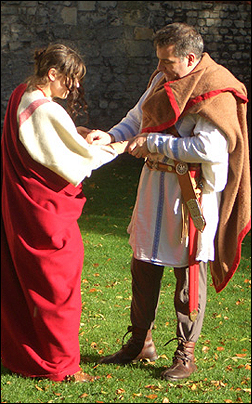
The lady is keen to follow the fashions set by the wife of the Emperess Julia Domna, with curled hair and heavy make-up. She wears an under dress in linen, woollen overdress with integral clavi, and a palla. Her shoes are delicate boots with integral laces and pieced decoration.
The soldier wears a heavy pair of boots with integral laces, trousers with integral feet, and a linen tunic decorated with clavi. His military belt is secured to belt studs through a square framed “buckle”. His pattern welded spatha is suspended by a wide baldric, decorated with silvered studs with phalera and strap end from Carlisle and Zugmantel respectively. The pair stand beside the city walls, re-modelled along the river frontage at this time.
Dateline A.D. 250’s
Dura Europus, Syria.
Flexible copper alloy scales seem to be normally smaller than iron examples, which generally seem to have been used for horse armour. Flexible armour was constructed by wiring each scale to its neighbours, then sewing the scales to backing fabric and to a horizontal woollen thread. The armour is then given leather edging for comfort. The resulting armour is quick to construct and relatively light. It is capable of expanding to allow for heavy breathing, as does mail. Its flexibility means it can be used for limb armour and be extended below the waist. Finds of loose scales or rows are often assumed to come from shirts, but may belong to limb defences. It is excellent against downward blows, good against horizontal strikes, and better than expected against upward stabs. The stitching, horizontal cord and wire all act against upward blows. Here a flexible scale coif, shirt and sleeves are worn based on the Dura Synagogue mural, the Battle of Eben-Ezer.
The broad baldric is based on an example from a votive deposit at Vimose, Denmark. Here it suspends a very pointed semi-spatha, again based on a find from Kunzig. The greaves are of a type seemingly used by infantry, with a material backing worn of leg wrappings. A quiver of javelins is carried as seen on a tombstone of Aurelius Mucianus from Legio II Parthica based in Syria. The oval shield, now planked with a sewn rawhide edge is based on those from Dura. A spear is carried decorated in the fashion of finds from Danish bogs.
Dateline A.D. 250
Cavalryman.
This assemblage owes a great deal to the Straubing Hoard, and the cavalry sports.
The chamfron consists of three panels joined by two long hinges. A naked Mars dominates the central panel which tampers slightly towards the base. The side plates have flying Victories around the top, snakes curving around the eye-guards and the Dioscuri with their horses near the lower edge. The horse also wears a silvered breastplate.
The cavalry sports greeves, ocreae, have detached knee guards hinged to the greaves, elaborate bossing with a silvered background, and cover the ankles. A naked Mars can be seen on the left greeve.
The painting on the parade shield is loosely based on fragments of a preserved painted circular leather shield facing, found in Egypt, now on display in Trier. The umbo is from the ex Guttman collection showing Minerva, in tinned copper alloy.
The rider wears a well upholstered auxiliary cavalry helmet from the early 3rd century, and flexible scale armour. The helmet padding was causing large amounts of sweat to colour the broad baldric holding the pattern welded spatha. On this very hot day linen trousers and tunic are worn, with a well built pair of typical 3rd century boots with integral laces.
Dateline A.D. 320
Roman cavalry group.
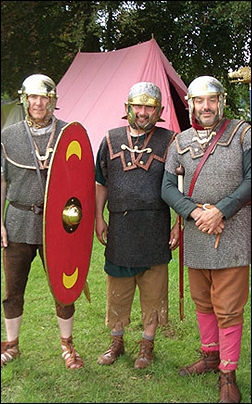
Mass produced Dominate helmets fall into two groups, either the ridge helm, at its simplest composed of two halves joined by a central ridge, or the spangenhelm, composed of several panels riveted into an iron frame. The ridge helms are provided with neckguards and cheek-pieces attached to a leather edging or fabric lining often without the use of metal hinges. The iron edges of the helm are not even properly finished, but left raw and bound with leather or rawhide. They were often sheathed in gilded silver foil. The centre and right hand riders are wearing examples of the Deurne helmet exhibited in the Leiden Museum. Individual pieces of gilded sheathing were discovered in 1910 in a flattened state. They were passed to a local goldsmith who assembled the pieces and “re-inflated” them into the presumed shape of the helmet.
When viewing the original in Leiden Museum, it noticeable that its hinge protectors have been mounted upside down. The left hand rider wears a copy of the iron helmet found in Egypt at Deir el Medineh, and is now on display at the Coptic Museum, Cairo.
All helmets need some form of padding. Vegetius referred to the “pilleus Pannonicus”. The Pannonian cap can be identified with the hats worn by soldiers on the Arch of Constantine. Shaped liked a pillbox, it is particularly suited to the shape of the ridge helm. On the right hand rider a Germanic style type 1 spatha can be seen, worn from a waist belt. A glimpse of the padded subarmalis can be seen, with attached leather pteruges, protecting the wearer’s upper arms and legs. Over this is worn rigid scale armour consisting of copper alloy scales wired to their neighbours, top, bottom and both sides. It is given a linen backing and leather edging. The relative inflexibility means that rigid scale shirts do not extend below the waistline. It is relatively light, but gives excellent protection, the force of a direct blow hitting any individual scale been quickly dispersed to the neighbouring scales. Although 4th century shirts leave no evidence, reconstructions of scale body armour are generally made with an opening on the left-hand side. This means the fastenings are protected by the wearer’s shield. The hardened leather thigh guards come are based on one of the two finds from Dura. An early form of lamellar, these fit from the waist over the knee to partially cover the shin above the military boot. A manica is worn protecting the right arm, while the shield, displaying the blazon of the Equites Talfali, protects the left. A recurve bow is carried to the riders left, and arrow to the right. The horse barding is in part based on drawings of the destroyed Column of Theodosius copied by Franco Giovanni Battista il Semolei in the 16th century, now in the musée du Louvre. In all a speculative assemblage.
Dateline late 4th century.
Northern Britain.
This infantryman is armed with an arcuballista or crossbow. Two 3rd century carvings of hunting equipment from the Haute-Loire region of France seem to show such weapons. A recurve bow of probably composite construction is mounted on a tiller, with a revolving circular bone nut as part of the trigger mechanism. A wooden handle is placed at the end of the tiller. The trigger itself is probably a simple “Z”-shaped lever, as used on all early crossbows. The operator places his right hand on top of the handle, forcing the bow into the ground vertically, while the string is pulled back and secured to the nut with the left hand. He is wearing a so-called Coptic tunic, based on surviving examples from Egypt. Tight trousers are worn, tucked into sprang-work socks and low shoes. His spatha is worn on a waist belt, under a broad military belt. His propeller shaped belt stiffeners date the figure to the late 4th century.
Dateline late 4th century.
Northern Britain.
A marine from a lusoriae, a small fast warship with a single bank of oars developed during the late 3rd century. These could be pictae or ships painted blue for scouting duties as a simple form of camouflage. Tunics are described as a blue-green colour, venetus, by Vegetius, who writes that the same colour was used for the sails of ships. Trousers are worn with simple leg wraps and heavy boots. The falx, a type of sword with a curved blade, seems to have been used in the Classis Britannica, as shown on a coin of Carausius. It is certainly mentioned by Vegetius as been useful in cutting rigging when attached to a long pole. Such a weapon could be made from un-hardened iron.
Dateline 4th century.
Cristae.
A crested so-called infantry ridge helmet from Intercisa, with a solid iron fin, gilded. Called the Intercisa IV, the reconstructed bowl, cheek pieces and neck guard may not have orignally belonged to the same helmet. Note the gilded copper alloy Chi-ro helmet label attached to the front of the crest. The helmet on the right is based on the Augst example, with a detachable wooden crest box attached to the central ridge. Ammianus mentioned Cristae in the second half of the 4th Century. A Carslie-type scale gorget is also on display.
Dateline A.D. 440
Gaul.
One of the bucellarii or bodyguards to a wealthy landowner is hunting with a recurve bow. This was based around a wooden core, upon which animal sinew and horn had been carefully glued producing a recurved shape. “Ears” were then attached to the ends of the bow, protected by bone or antler. These acted as levers for the flexible parts of the limbs. Laths on the grip stiffened the bow handle to prevent it flexing and bucking when the string returned to rest after release. Vegetius referred to the “pilleus Pannonicus”. The Pannonian cap can be identified with the hats worn by soldiers on the Arch of Constantine, with a simple pillbox shape.
Dateline late 6th century.
Saxon
This warrior wears a wrap over jacket, sometimes called a warrior or riding jacket, based on the images from the Sutton Hoo helmet, and those from Vendel I and XIV plus Valsgarde 7. Indeed the same style of coat appears on impressed gold foils from Denmark, southern Sweden, Germany and the UK. All show a wrap-over garment with wide boarders at the front, hem and sometimes the cuff, covering to the knee, fastened by a wide belt with no sign of buckle. Tight footed hose are worn with one piece shoes. The sword is fastened with an ornate triangular buckle. The helmet is a broadband type with a bowl-like shape, devoid of decoration and purely practical. Probably derived from eastern examples, this version is similar to that from St. Vid with two semi-circular plates filling the broad frame. The single example from the UK, the Shorwell helmet has four in-fill plates and perhaps shows Merovingian influence in the southern part of the country. It is feasible some examples had neck and cheek guards of mail or organic materials. Here a speculative decorative arming cap is worn.
Dateline late 6th century.
British horseman
Based on the poem Y Gododdin, complete with a rugged horse, a swan-white steed. The rider carries a Germanic type 1 sword, short javelins in a quiver and good size planked shield covered in leather. No mail or scale is worn. In the poem, mentions of armour are easily outweighed by mentions of shields. There are no categorical mentions of helmets in the Gododdin. Shoes are based on those from an Irish crannog, with simple onion dyed nalbinded low socks. By this time in Britain Roman four horned saddles would be almost 200 years old. A simple steppe saddle could have been used for high status warriors, but for predominately skirmishing cavalry bareback is fine. A saddle cloth could be used to keep the horse sweat from the rider. A padded saddle cloth would help if the horse had a bony back.
Dateline late 6th century.
North Africa.
The army of Justinian.
This figure is loosely based on the Ashburnham Pentateuch. A woollen tunic is worn under mail and leather scale. Linen bracae are worn with high wide boots with knee extensions. The soldier carries a Germanic spatha and Gothic spangenhelm. A heavy woollen kandys or long sleeved coat is draped over the shoulders.
Dateline A.D.900
Kabarian Khazar Rus mercenary
in Byzantine service.
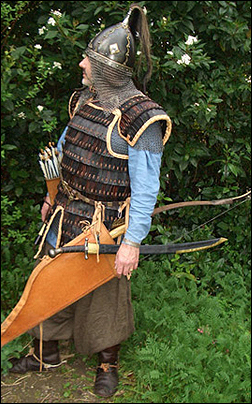
An iron helmet with some gold plate of Kabarian workmanship, worn with a basic Kabarian sabre. The armour is mail worn under a form of leather lamellar. Loose riding trousers are worn with riding boots and Scandinavian style spurs. The belt and pouch fittings come from burial mounds (16 and 160) Smolenskaja. A whip is carried, as well as a quiver and strung bow in it’s case. The assemblage speaks of a fusion of cultures.
Dateline A.D. 1040
Varangian in Anatolia
Rather than a member of the Emperor’s axe bearing guard, first recruited around AD 988-990, this man is probably part of a band contracted for a set period, like those brought to Byzantium by Harold Sigurdson. He has brought his equipment with him, the primary weapon being the broad Danish axe, called the dzikourion since they were worn on the right shoulder. The sword of Frankish manufacture is carried on a narrow waist belt. A mail shirt worn over padding is complimented by iron splint arm and leg defences. The helmet is a segmented spagenhelm with nasal.
Dateline Fouth Crusade 1202-1204
Knight Templar
The Fourth Crusade rather than attacking Ayyubid Egypt, first attacked the Zadar in modern Croatia before sacking the Byzantine capital of Constantinople. Although the remains of the Eastern Roman empire would survive, vast quantities of booty were shipped back to Western Europe. The short-lived Empire of Romania emerged from its ruins. However the few knights who reached the Holy Land in 1203 were able to help extend the Kingdom of Jerusalem and stabilise its frontiers. This reconstruction is largely based on the frescos in Knights Templar chapel of Cressac, Charente, in south western France. Full mail is worn over padding, covered by a monastic tunic, a capae, and cloak. The flat top helmet has a face plate. Horses would still be around 14 hands.
Dateline A.D. 1204
The Latin Empire of Constantinople.
Count Baldwin of Flanders was the first Latin Emperor after the capture of Constantinople during the Fourth Crusade. Here we have a Flemish knight in an early version of a great helm, mail hauberk with integral coif, and mail chausses covering the outside front of his legs, secured to a belt at the waist.