


The full cavalry display is crowd pleasing spectacular which involves all of the cavalry weapons in a round of exciting competitions, demonstrating the power of specially selected and trained horses as well as the skills and tactics of both riders and infantry!
Comitatus has researched and developed its own Late Roman cavalry squadron, representing the elite of the late Roman army. The influence of steppe horseman such as the Huns, Goths and Sarmatians are clearly to be seen. The public love the beautiful horses, the thunder of hooves and the crack of sharp javelins punching through the targets.
Our Roman Cavalry squadron is the best, largest and safest in Britain, pushing authenticity and experimental research to new heights for the period. We reconstruct Roman cavalrymen from the Republican period through to the fall of Constantinople. However we specialise in recreating the late Roman cavalry unit, the Equites Taifali. We manufacture and sell Roman saddles and help other cavalry groups set up to enjoy the unique challenge of riding as Romans.
Our full cavalry display includes demonstrating control of the horse without stirrups, using the contus - a 4m long spear held in both hands - at the gallop, the spectacular damage inflicted by sharp weapons on static targets, attacking infantry formations in the 'Cantabrian Circle' with javelins, darts and horseback archery and riding down specially trained stunt legionaries with javelins, throwing darts, swords and lances.
After the display, the public get the chance to meet the riders and pet the horses.

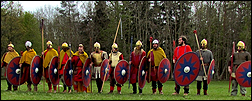
Rather than 'battle re-enactment', our infantry shows are based on a professional scripted 30 minute display designed not only to educate but to entertain the public. Not only is the clothing and equipment of the very highest standard, but we actually use it in a series of displays based on manuals of the period. Weapons are not blunt but razor sharp to inflict maximum damage.
Using Latin drill we demonstrate a variety of sharp missile weapons designed to kill and cause mayhem, as well as combat sparring with training weapons. An element of theatricality enables the performers to interact with the crowd, and whenever possible we provide an opportunity for young members of the public to experience things first-hand.
Alongside Latin drill and elements of reconstruction archaeology, the public get to cheer for their favourites and engage with the performers.
We also have our own iron-framed bolt-shooting ballista, possibly the most powerful in the country. It can be tensioned to suit most arenas, and literally gives our infantry display a high impact.
The public will also be able to have the opportunity to talk to the soldiers, in and out of the arena. This allows them to ask soldiers questions and get up close to the weaponry and equipment they used.
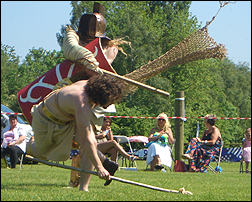
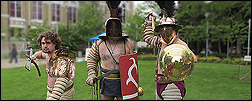
Our display offers a thrilling and entertaining insight into gladiatorial fighting in the arena, the skill of each competitor and his struggle to become a champion.
The crowd is encouraged to participate, with the help of Charon and his humorous antics, and the lanista who controls the scoring. A series of exciting combats are presented and the crowd can choose their favourites to cheer on. There are also opportunities for the younger members of the audience to train as gladiators.
The accuracy and quality of our equipment is second to none. Forget Hollywood, and experience the real life and times of a Roman gladiator.
Out of the arena the public are able to get up close to the very high quality armour, weaponry and equipment used. They are able meet the gladiators, learn about their way of life, and meet our Medicus, who learnt his gory profession with the bodies of fallen gladiators!


Comitatus can display with horses, birds, dogs and ferrets to put on colourful hunting displays from the past. The display can include falconry, archery with self bows, recurve bows and cross bows, the making and use of nets and hides, stalking horses and all the other equipment of the hunt. This is popular along side our standard displays as part of a festival.
We work with our clients to develop shows that suit their needs and their budget. We have a massive range of arms, armour, clothing, saddles and other equipment. We have helped clients stage everything from Celtic Festivals to medieval knights.
So if you have a heritage project and you would like something special to help engage an audience then please get in touch.


The full cavalry show is a unique and breathtaking event. Only Comitatus can field a file of cavalry from the classical period. The display uses various Greek and Scythian cavalry to illustrate the classical period, riding bareback at speed and sometimes without reins.
Elements of trick riding are used to show how the ancients mounted their horses both stationary and on the move. Scythians from the steppes can demonstrate bareback horse archery and give a barbarian counterpoint to our more western Greeks and Macedonians.
As ever our equipment is of the highest quality, much of it made by the group. The show has real visual impact. But if a sword or helmet can fire the public’s imagination, people gain far more from seeing the equipment in action, on horseback at speed.
Using period writers upon which to base our displays, our riders and horses demonstrate a variety of skills and tactics from the period with the help of specially trained “stunt” infantryman, or as they like to be called, “the bravest of the brave”.
After the display, the public get the chance to meet the riders and pet the horses.


As with all our shows this is a professional scripted display rather than a traditional ‘battle re-enactment'. Our weapons are sharp and designed to cause maximum damage. We aim to entertain and educate the crowd, and engage them by introducing an element of theatricality in some parts of the display.
Taking the Athenian writer Xenophon as a guide we demonstrate a snap shoot of Greek military life, between the great wars against the Persian Empire and the conquests of Alexander. In some ways a time when the more formal disciplined structures of the later Roman army have yet to be developed. Women play a part in the display, and we demonstrate clothing as well as a variety of missile weapons, Greek sports such as wrestling, and combat sparing.
Where possible encourage children to take part in the display and experience things first hand. The public will also be able to have the opportunity to talk to the peltasts and mercenaries, in and out of the arena. This allows them to ask questions and get up close to the weaponry and equipment they used.


We aim to both educate and entertain, positively engaging the public. Children are encouraged to feel, touch, smell, carry and generally get a good hands-on experience within the encampment. We explain who we are and what we are attempting to portray and bring them a little closer to the reality of ancient life.
During the period frontier soldiers would have practiced many different crafts to help feed their households. Soldiers could be accompanied by their families on campaign, and Comitatus is very much a family oriented society. Much of the equipment used by the group is made by our members, and learning new skills is always encouraged.
The range of skills and knowledge we can offer is amazing and we can offer time-tabled talks and tours to bring the best out of our encampment. We have traders, armourers, weavers, basket-makers, dyers, woodworkers, net-makers, bakers, surgeons, bone-workers, potters and cooks! Our campsites really are the bustling little communities they appear to be!
One of the aims of Comitatus is to discover more about everyday life in Late and Post-Roman Britain by experiencing elements of it for ourselves and to present it to others. While our experimental reconstructions increase our technical knowledge of the period, we often feel that we understand it most in the commonplace: the pace of cooking on a wood fire, the satisfaction of eating with a spoon that you carved yourself, the sound made by approaching rain.
The tented encampment that the group sets up at an event is not set dressing, but where we rest, repair kit, cook, eat, socialise and sleep after the public has gone. During the day, members present the craft skills known to have been practised by the people of the day to make ends meet, both the 'civilian' population and professional legionaries and their families.

We have welcomed opportunities to work with Time Team, universities and various small Trusts and organisations dedicated to opening up history to a wider audience. If you have a project, get in touch.
Members participate in archaeological and living history conferences and are sometimes available to give talks and small scale displays at suitable events.
Comitatus was the major sponsor of the Late Antique Archaeology 2007 Conference at the Ashmolean, Oxford. This partnership acknowledged our commitment to authenticity and to experimental archaeology. We maintain close links with the University of Kent.

We wish to make a genuine contribution to knowledge of the period.
Comitatus endeavours to reconstruct military equipment based on archaeological finds, period iconography and written evidence.
The group uses its reconstructions to produce and publish information and hard data on the late Roman army. Members of the group give academic papers on late Roman military equipment and have appeared on television, radio etc.