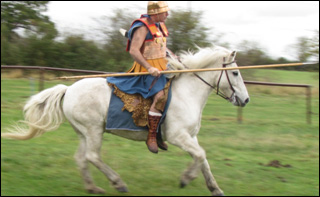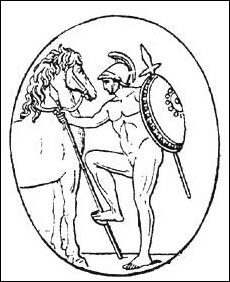
Probably a Roman seal ring showing a shielded horseman mounting using a spear.
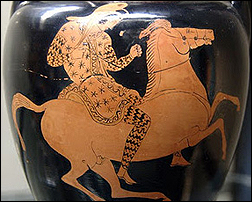
The Chair seat, criticised by Xenophon.
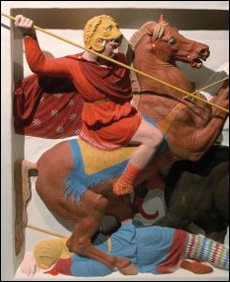
Alexander in control!
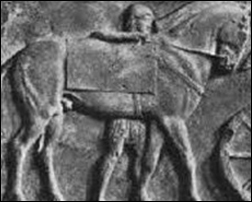
A simple sadle pad
Xenophon and the Greeks
Greatly influenced by Persian horsemanship, the Athenian Xenophon is our starting point. Although perhaps not the first or the second oldest known historical writer, he is the first for which we have a large body of work. Written in around 350 BC, the two treatises "On Horsemanship" and "The Cavalry Commander" were considered the earliest extant works on horsemanship until the publication of a Hittite by Kikkuli of the Mitanni Kingdom, which dates from about 1360 BC. A treatise on horsemanship by Pliny the Elder is believed lost, as was that by Simon of Athens, which is twice mentioned by Xenophon in "On Horsemanship". However some fragments of Simon's treatise survive.
Xenophon describes how the rider should mount, taking the rein loosely in his left hand either gripping the mane near the ears or using his spear while with his right hand hold bridle and mane at the point of the shoulder. He would draw himself up with his left hand, while also using his right to lift himself, throwing his right leg across the horse without resting his knees on the back of the horse. Much influenced by Persian horsemanship Xenophon follows Persian fashion in suggesting that the groom should know how to give his master a leg-up in the Persian fashion, if the master was old or infirm.
Rather than sitting on the horse's rump as if in chair with bent legs, the rider sat forward with the lower leg and foot hanging lax and easy from the knee downwards. The body above the hips was kept as loose as possible to help the rider withstand tiredness and be less likely to be pulled or pushed off in combat. The lower legs and foot could be protected by a boot made of sandal leather. This helps the rider feel every movement of the horse's back muscles and sense what the horse is doing and about to do.
Xenophon suggests that horses' hoofs could be hardened by getting them to stamp on a bed of hard round stones. "No foot, no horse" as the old maxim goes. A thick quilted saddlecloth could help protect a horse's back and prevent sores. A pad could also make horses with a protruding bony spine more comfortable for their riders. Xenophon recommends a horse with a "double back", a recessed backbone with enough muscle either side to support the riders pelvic bone. Squadrons may have adopted a saddle cloth of uniform colour, and officers liked leopard skin. Both are useful for keeping horse sweat from the rider. A broad comfortable back would have made for a comfortable ride and a good weapons platform. Xenophon states that reins should match the leather of the bridle and not be weak, slippery or too thick. Cavalrymen would march on foot as much as possible to save their mounts, and the health of their horses would be their prime concern.